
In the modern landscape of health and wellness, few metrics are as ubiquitous, debated, and essential as the Body Mass Index (BMI). Whether you are visiting a primary care physician for a routine check-up, applying for a life insurance policy, or tracking your fitness journey via a smartphone app, the BMI calculator remains the primary screening tool used to categorize individuals into weight-related health categories. Despite the emergence of advanced body composition technologies, this simple mathematical ratio continues to serve as the global standard for assessing weight-related health risks.
This comprehensive guide delves into the mechanics of the BMI, the industry standards that govern its use, and the critical nuances often overlooked in mainstream health discussions.
The Evolution of the Body Mass Index: From Statistics to Standard
The origin of the BMI is not rooted in modern medicine but in 19th-century social statistics. Developed by the Belgian polymath Adolphe Quetelet between 1830 and 1850, it was originally dubbed “Quetelet’s Index.” Quetelet was not a physician; he was a mathematician and astronomer who sought to define the “average man” through statistical means. It wasn’t until 1972 that researcher Ancel Keys officially renamed it the Body Mass Index, proving it to be a more effective proxy for body fat percentage than previous methods like simple height-weight tables.
Today, federal and international health agencies rely on this metric to monitor population health. According to the [CDC – About Adult BMI], it is a reliable indicator of body fatness for most people, used to screen for weight categories that may lead to health problems. While it does not measure body fat directly, it correlates highly with more direct measures of body fat, such as dual-energy X-ray absorptiometry (DXA) scans.
Decoding the Mathematics: The BMI Formula and How It Works
The beauty of the BMI calculator lies in its simplicity. It requires only two data points: height and weight. This accessibility allows individuals and clinicians to perform rapid assessments without the need for expensive equipment.
The BMI formula is calculated using two primary methods depending on the system of measurement:
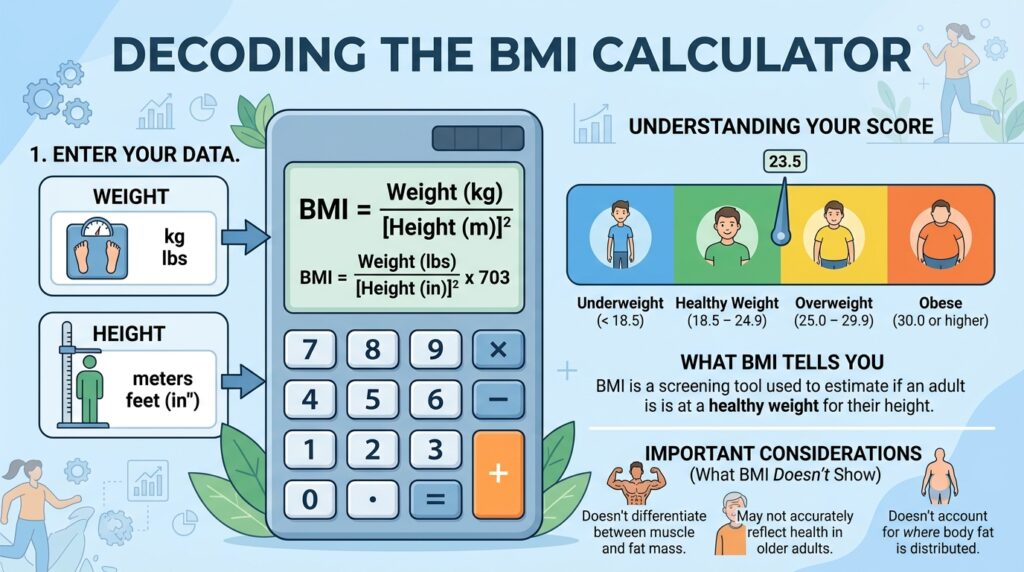
1. Metric System: BMI = weight (kg) / [height (m)]²
2. Imperial System: BMI = 703 x weight (lbs) / [height (in)]²
In the imperial version, the multiplier (703) is used to convert the units into the same scale used by the metric system. The resulting number provides a standardized score that places an individual on a spectrum ranging from underweight to class III obesity. Understanding this BMI formula is the first step in taking control of one’s metabolic health data.
Navigating the BMI Chart: What Your Numbers Truly Mean
Once a calculation is performed, the result is compared against a standardized BMI chart. This chart is the industry-standard benchmark used by global health organizations to define risk categories. The [World Health Organization – Global BMI Data] provides an extensive look at how these numbers vary across different populations and the rising trends in global obesity rates.
The standard weight status categories associated with BMI ranges for adults are:
* Below 18.5: Underweight
* 18.5 – 24.9: Healthy Weight
* 25.0 – 29.9: Overweight
* 30.0 and Above: Obesity
Within the obesity category, there are further sub-classifications:
* Class I: BMI of 30 to < 35
* Class II: BMI of 35 to < 40
* Class III: BMI of 40 or higher (sometimes referred to as “severe” or “morbid” obesity)
It is crucial to recognize that the BMI chart is a screening tool, not a diagnostic one. A high BMI may prompt a clinician to perform further assessments, such as skinfold thickness measurements, dietary evaluations, and blood tests to monitor glucose and cholesterol levels.
Specialized Considerations: The BMI Calculator for Women
While the basic formula remains the same regardless of gender, the interpretation of results often requires a more nuanced approach when using a BMI calculator for women. Biological differences in body composition play a significant role in how weight relates to health. On average, women tend to have a higher percentage of total body fat than men at the same BMI.
Hormonal fluctuations, pregnancy, and menopause significantly alter fat distribution. For instance, during and after menopause, women often experience a shift in fat storage from the hips to the abdominal area. This “visceral fat” carries higher health risks than subcutaneous fat, even if the BMI calculator result remains within the “healthy” range. Furthermore, during pregnancy, the standard BMI categories are inapplicable, as weight gain is a physiological necessity.
For a deeper dive into how these metrics influence female health specifically, the [WebMD – BMI Calculator and Information] resource offers tailored insights into weight management and the physiological factors that can influence your score.
The Industry Perspective: Why Insurance and Healthcare Pivot Around BMI
The healthcare and insurance industries are driven by risk assessment, and the BMI calculator is their most cost-effective tool. From an actuarial standpoint, BMI is a powerful predictor of morbidity and mortality.
1. Life and Health Insurance Premiums
Insurance companies use BMI to help determine “ratings” for policyholders. A BMI that falls into the “obese” or “underweight” categories may result in higher premiums or, in some cases, a denial of coverage. This is because statistical data shows a strong correlation between high BMI and chronic conditions such as Type 2 diabetes, hypertension, and cardiovascular disease.
2. Clinical Preventative Care
In a clinical setting, the [National Heart, Lung, and Blood Institute – BMI Calculator] is often the first step in a preventative care protocol. By identifying patients in the “overweight” or “obese” categories early, healthcare providers can intervene with lifestyle counseling, nutritional guidance, and exercise prescriptions before chronic diseases manifest.
3. Corporate Wellness Programs
Many large corporations have integrated BMI tracking into their employee wellness programs. By incentivizing employees to maintain a healthy BMI through gym memberships or health insurance rebates, companies aim to reduce absenteeism and lower overall healthcare expenditures.
Limitations and the “Athletic Paradox”
Despite its widespread use, the BMI calculator is not without critics. The most significant limitation is its inability to distinguish between muscle mass and fat mass. Because muscle is much denser than fat, highly trained athletes or bodybuilders often find themselves classified as “overweight” or “obese” according to the BMI chart, despite having very low body fat percentages.
This “Athletic Paradox” highlights the necessity of using BMI in conjunction with other metrics like waist-to-hip ratio and body fat percentage. Furthermore, ethnic differences in body composition mean that certain populations may face higher health risks at lower BMI thresholds. For example, some research suggests that individuals of Asian descent may have a higher risk of diabetes at a BMI as low as 23.
The [Mayo Clinic – BMI Calculator Assessment] emphasizes that while BMI is a helpful starting point, it is only one piece of the puzzle. Factors such as age, muscle mass, bone density, and overall lifestyle must be considered to provide a complete picture of an individual’s health.
The Future of Metabolic Screening: Beyond the Calculator
As we move further into the era of personalized medicine, the industry is seeing a shift toward more comprehensive metabolic profiles. While the BMI calculator will likely remain a staple due to its zero-cost implementation, it is increasingly being supplemented by:
* Bioelectrical Impedance Analysis (BIA): Found in many modern smart scales, this technology sends a weak electrical current through the body to estimate body fat and muscle mass.
* 3D Body Scanning: Emerging in high-end fitness centers, these scanners create a digital avatar to track changes in body shape and volume over time.
* Metabolic Blood Panels: Measuring insulin sensitivity, C-reactive protein (inflammation markers), and lipid profiles to assess health regardless of weight.
Practical Applications: How to Use BMI Data Effectively
For the average consumer, a BMI calculator should be viewed as a “smoke detector.” It is an early warning system that indicates when it might be time to take a closer look at your lifestyle habits. If your BMI moves from the “healthy” to the “overweight” category, it serves as a prompt to evaluate your caloric intake, physical activity levels, and sleep hygiene.
When using a BMI calculator for women or men, consistency is key. Tracking your BMI over months or years can reveal trends that are more important than a single snapshot in time. A steady upward trend in BMI, even within the healthy range, can be a precursor to metabolic slowing and should be discussed with a healthcare professional.
Summary: A Tool for Population Health
The Body Mass Index remains a cornerstone of the health industry because it provides a common language for researchers, clinicians, and the public. While it is not a perfect measure of individual health, its utility in identifying trends and risks across large populations is unparalleled.
By understanding the BMI formula, navigating the BMI chart with a critical eye, and recognizing the specific needs highlighted by a BMI calculator for women, individuals can use this metric as a stepping stone toward a more comprehensive understanding of their physical well-being. It is a starting point—a simple, effective, and scientifically backed method to initiate the complex conversation of what it means to be healthy in the 21st century.
Whether you are using the [National Heart, Lung, and Blood Institute – BMI Calculator] for a quick check or reviewing the [World Health Organization – Global BMI Data] to understand the broader context of human health, the Body Mass Index continues to be one of the most vital tools in the global effort to improve longevity and quality of life.